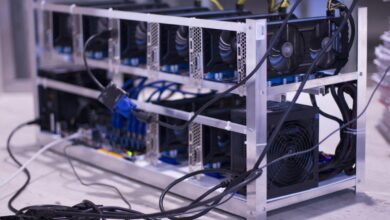

Before you order any hardware, your first step is calculating the break-even point. This is not a speculative guess; it is a precise figure derived from your local electricity cost in pence per kWh, the power draw of the mining hardware, and its current market price. For example, a rig drawing 1500W at an electricity cost of 34p/kWh incurs a daily energy expense of £12.24. If the hardware costs £4,000, the machine must generate enough rewards to cover over £16,000 in electricity costs alone before it turns a profit. This pre-investment calculation separates viable projects from financial losses from day one.
Accurate forecasting requires estimating two volatile variables: network difficulty and asset price. The mining difficulty of a proof-of-work algorithm like SHA-256 adjusts regularly, directly impacting your potential rewards. A static calculation based on today’s numbers is useless. Your model must project how increasing difficulty will erode your returns over the next 6-12 months. Combine this with a conservative price forecast for the mined asset; relying on current all-time highs distorts your ROI analysis. Use historical difficulty charts to build a depreciation model for your hardware’s output.
For beginners, this process hinges on a structured methodology, not intuition. Use a dedicated profitability calculator, inputting your specific hardware model, electricity tariff, and a pool fee. The algorithm will output a projected timeline for returns. Your final decision should be binary: if the calculated ROI extends beyond 18 months, the investment carries significant risk due to the probability of rising difficulty and market volatility. This disciplined, data-centric approach is the only reliable strategy for assessing mining profitability before committing capital.
Hardware Hashrate and Power
Begin your analysis by treating hardware as a financial asset, not just a piece of tech. Your hashrate is your direct revenue engine; a higher rate increases your share of block rewards. However, this is only half the equation. The true metric for calculating profitability is efficiency, measured in joules per terahash (J/TH). An Antminer S19 XP with 140 TH/s at 21.5 J/TH will generate significantly better returns than an older S19j Pro at 100 TH/s at 29.5 J/TH, even with the same electricity cost, because it produces more work for less power.
The Electricity Cost Ceiling
Your local electricity price in pence per kWh sets a hard ceiling on viable mining hardware. For example, at 28p/kWh, running an inefficient 3000W rig could cost over £600 monthly just in power. Before investing, run a break-even analysis: divide the hardware’s daily power cost by its potential daily earnings. If the power cost is 70% of the income, your margin for error against rising network difficulty is slim. Hardware with a lower J/TH rating is your primary defence against volatile energy markets, making long-term roi forecasting more reliable.
Forecasting Against Rising Difficulty
Static profitability calculators are misleading for beginners. A machine generating £10 per day today might only yield £6 in six months as the network difficulty increases. Your hardware analysis must include estimating how future difficulty adjustments will erode returns. Use historical difficulty charts for your chosen algorithm (e.g., SHA-256 for Bitcoin) to model a conservative growth rate of 5-10% per adjustment. This data-driven approach reveals the true payback period, often pushing the break-even point months beyond optimistic initial calculations. Factoring this in is non-negotiable for accurate roi estimating and protecting your capital.
Electricity Costs Calculation
Your electricity rate is the single most critical variable in mining profitability. A miscalculation here turns a projected profit into a permanent loss. For a precise pre-investment analysis, you must move beyond average national rates and find your exact pence per kilowatt-hour (kWh) on your energy bill. A unit cost of 24p/kWh versus 34p/kWh can be the difference between a viable operation and a non-starter.
The Break-Even Power Price
Instead of just calculating costs, reverse the equation to find your maximum allowable electricity price. For any given hardware, use a mining calculator inputting your hardware’s power draw, the current network difficulty, and coin price. The goal is to identify the power cost at which your daily rewards precisely equal your daily electricity expenditure. This is your break-even point. If your actual tariff is higher than this figure, your mining venture will operate at a loss from day one, regardless of future price speculation.
Forecasting long-term returns requires modelling electricity as a constant drain against volatile rewards. While estimating future coin value is speculative, your power bill is a fixed, predictable cost. A robust ROI calculation must account for this. For example, an ASIC miner drawing 3.2kW costs £2.30 per day at 30p/kWh. Over a year, that’s £842 solely in electricity, which must be subtracted from the value of mined coins before any profit materialises. This direct cost analysis separates hopeful beginners from disciplined investors.
Incorporating Difficulty Increases into Your Model
A static profitability calculation is dangerously misleading. Network difficulty routinely increases, reducing your share of the mining rewards over time. Your forecasting must simulate this. If your hardware generates £5 of coin today but electricity costs £3, your net profit is £2. However, if network difficulty rises 10% next month, your rewards could drop to £4.50, slashing your net to £1.50. Continuous difficulty hikes can push your operation below the break-even threshold, making power costs the ultimate determinant of your hardware’s operational lifespan.
This rigorous approach to calculating energy consumption transforms mining from a speculative gamble into a data-driven investment. By locking down your largest variable cost, you create a stable foundation for profitability analysis, enabling you to make informed decisions on hardware selection and operational strategy.
Using Online Profitability Calculators
Input your hardware hashrate and power draw first. The most accurate pre-investment analysis comes from using data for a specific mining rig, like an Antminer S19 XP, rather than generic selections. This precision is critical for estimating your true operational costs.
Your local electricity rate, in pence per kWh, is the most decisive variable. A calculator will show that at 12p/kWh, a rig might be profitable, but at the UK average of 24p, it could operate at a loss. This directly impacts your break-even point and overall roi. Never rely on default electricity costs; your tariff is unique.
Beyond Static Numbers: The Role of Network Difficulty
Basic calculators provide a snapshot, but sophisticated tools project returns by modelling increasing network difficulty. If the algorithm adjusts to make mining harder every two weeks, your rewards diminish over time. Look for calculators with a difficulty increase forecasting feature, allowing you to see how your daily income might halve over six months.
For a realistic profitability outlook, run multiple scenarios. Calculate your roi with static difficulty, then with a 5% monthly increase. This stress-test reveals the sensitivity of your investment to market competition. Beginners often overlook this, leading to over-optimistic returns.
Interpreting the Data for a UK Investor
The final output is not a profit guarantee but a probability model. It tells you the conditions required for success. If the calculator indicates a 200-day break-even only if difficulty remains flat, you know your investment carries significant risk. Use this analysis to decide if the potential upside justifies the capital outlay, or if your funds are better deployed elsewhere.