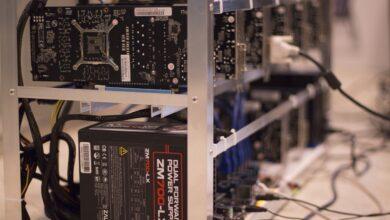

Ignore any suggestion to begin mining today without first analysing the silicon that powers it. The progression from a standard CPU to specialised ASIC rigs defines the entire economic structure of blockchain validation. My first mining attempt in 2014 ran on a repurposed gaming PC; its GPU hummed for weeks to earn a fraction of a Bitcoin, a stark contrast to the industrial-scale farms operating now. This isn’t just a story of software development; it’s a physical battle, an arms race measured in terahashes per second and joules of energy consumed.
The origins of this race lie in Satoshi’s implementation of the proof-of-work consensus algorithm. This digital gatekeeper required provable computational effort to secure the network, intentionally linking the creation of new currency to real-world resource expenditure. Early adopters quickly discovered that a computer’s central processing unit was hopelessly inefficient for the specific cryptographic algorithms involved. The shift to Graphics Processing Units (GPUs) marked the first major hardware advancement, turning gaming components into instruments of financial gain and setting a precedent for the rapid obsolescence of mining technology.
This relentless pursuit of hashing power inevitably led to the application-specific integrated circuit (ASIC). These chips, designed solely to execute the SHA-256 algorithm for Bitcoin, rendered all previous hardware obsolete almost overnight. The development of ASICs created a stark divide: it consolidated mining power among those with the capital to access this new technology, directly challenging the decentralization ethos that underpinned the crypto movement. The profitability calculus shifted from a hobbyist’s electricity bill to a boardroom’s analysis of energy contracts and hardware procurement cycles.
Consequently, the narrative of crypto mining is a dual-edged chronicle. It details a staggering technological advancement that has secured a multi-trillion-dollar digital asset class. Simultaneously, it highlights a growing tension between network security and its corresponding energy footprint, a debate that now drives the development of alternative consensus mechanisms. Understanding this hardware evolution is not academic; it is fundamental to forecasting the future distribution of power and profit within the blockchain ecosystem.
From CPU to ASIC
Analyse the hashrate progression on any major proof-of-work blockchain; the data tells a clear story of relentless hardware advancement. The chronicle of crypto mining began with CPUs, where early adopters ran simple software on standard computers to mine Bitcoin. This phase was short-lived, as developers quickly identified the superior processing power of GPUs. The shift from CPU to GPU mining marked the first major inflection point for profitability, fundamentally altering the mining landscape by introducing intense competition.
The GPU era democratised mining access but also sowed the seeds for its own obsolescence. As network difficulty skyrocketed, the hunt for greater efficiency led to the development of FPGAs (Field-Programmable Gate Arrays), a transitional technology. However, the true revolution was the Application-Specific Integrated Circuit (ASIC). An ASIC miner is hardware designed for a single purpose: executing a specific set of blockchain algorithms, like SHA-256, with maximum speed and minimum energy consumption. This specialisation rendered general-purpose hardware like GPUs economically unviable for mining established digital currencies like Bitcoin.
This technological arms race presents a critical trade-off: ASIC-driven efficiency versus network decentralization. The high cost and rapid development cycles of ASIC hardware concentrate mining power into large-scale operations, potentially undermining the distributed ethos of crypto. For a miner today, the decision is binary. To engage with a currency like Bitcoin, joining a professional mining pool with access to the latest ASICs is the only path to consistent profitability. Conversely, for those prioritising decentralisation, focus on alternative, ASIC-resistant cryptocurrencies that utilise memory-hard proof-of-work algorithms, which are better suited to GPU mining. The energy footprint of this entire progression remains its most contentious externalities, a direct result of the proof-of-work consensus mechanism’s security model.
Rise of Mining Pools
Join a mining pool; solo mining with modern ASIC hardware is a statistical lottery you will almost certainly lose. The progression of mining difficulty post-2012 rendered individual efforts futile for block rewards. Pools aggregate the hash rate of thousands of participants, creating a collective force that can consistently solve Proof-of-Work algorithms and distribute rewards proportionally, directly addressing the core issue of profitability for the average miner.
The chronicle of this development is a study in forced adaptation. As ASIC technology advanced, the energy and hardware costs to compete skyrocketed. The first major pool, ‘Slush Pool’, launched in 2010, established the model: coordinated software manages the work distribution, allowing GPU and later ASIC owners to contribute small slices of computational power. This model didn’t just save individual miners; it fundamentally altered the blockchain’s power structure, beginning a subtle centralization of hash power that continues to challenge the ideology of pure decentralization.
Examine the data from 2014, when a single pool, GHash.IO, briefly exceeded 51% of Bitcoin’s total network hash rate. This wasn’t a theoretical breach; it demonstrated a tangible risk where a dominant pool could potentially double-spend the digital currency or halt transactions. The market corrected, but the event remains a stark case study. The response was a technical and social one, with miners redistributing their power to other pools and a renewed development focus on alternative consensus algorithms less susceptible to such consolidation.
The long-term consequence is a professionalised mining sector. Your profitability now hinges on selecting a pool with transparent fee structures, reliable payout schemes, and a stable server infrastructure. The choice of pool is as critical as the choice of hardware. This ecosystem, built on a foundation of shared processing power, is the true engine behind the security of major Proof-of-Work blockchains, a necessary compromise that secures the network while concentrating influence in the hands of a few key pool operators.
Impact on Hardware Markets
The hardware market’s chronicle is a direct reflection of crypto mining’s progression. My advice is to track the development of ASIC manufacturers like Bitmain and Canaan as a leading indicator for the entire sector’s health. The initial surge in GPU demand, which saw AMD’s stock price increase by over 900% in 2017, was a market shock that exposed the fragility of traditional supply chains. This wasn’t mere consumer demand; it was an industrial-scale procurement race that created global shortages and permanently altered pricing strategies for companies like NVIDIA, who later introduced mining-specific CMPs to segment their market.
This hardware arms race directly challenged the decentralization ethos of blockchain’s origins. The proof-of-work algorithm, while securing the network, created an economy of scale where mining profitability became contingent on constant hardware advancement. The development of these specialized machines created a secondary market entirely dependent on crypto valuation, leading to cycles where mass ASIC liquidation floods the market after a price crash. This creates a feedback loop: cheaper hardware can increase network hashrate, but also centralizes control among those who can afford to continually upgrade.
The energy demand of this progression forced a hardware evolution focused on efficiency, not just raw power. Newer ASIC models are marketed on joules per terahash, a metric that directly impacts operational margins. For investors, this means analysing the release cycles of new hardware; a new, more efficient generation can render entire mining farms obsolete overnight, turning a profitable operation into a liability. The software and algorithms continue to evolve, but the physical constraints of the hardware dictate the real-world economics of securing a proof-of-work digital currency.