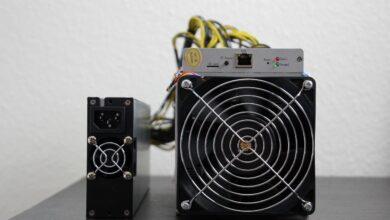

Forget any notion of competing with GPU rigs for serious SHA-256 mining; the data from 2023 makes the case incontrovertible. A modern Antminer S21 Hydro delivers 335 terahashes per second at 16 joules per terahash, while a hypothetical farm of the latest GPUs would require nearly 300 units and over ten times the power to achieve a similar output. This staggering disparity in performance and efficiency isn’t just an improvement; it’s a fundamental market shift. The proliferation of application-specific integrated circuit hardware has redefined the baseline for mining productivity, rendering all previous methods economically unviable for established cryptocurrencies like Bitcoin.
The dominance of ASIC miners stems from a singular design philosophy: the optimization of hardware for a single, repetitive task. Unlike general-purpose processors, an ASIC’s architecture is hardwired from the ground up to execute the Secure Hash Algorithm, and nothing else. This singular focus eliminates the computational overhead that plagues CPUs and GPUs, resulting in a direct translation of electrical energy into mining output. The emergence of this specialized hardware created a permanent schism, establishing a clear superiority in raw hashing capability that general hardware cannot bridge. The continuous advancement in chip lithography, now pushing into the 5nm and 3nm nodes, ensures this gap only widens with each new generation.
This technological arms race has profound implications for network security and individual profitability. The sheer computational power of the global ASIC network, now exceeding 500 exahashes per second, acts as the primary defence against a 51% attack, but it also raises the barrier to entry astronomically. For an operation to remain competitive, it requires constant capital reinvestment into the latest hardware and access to sub-5p per kWh electricity. The application-specific nature of this hardware means its entire value is tied to the continued viability of the algorithm it mines; a change in protocol can instantly obsolete a multi-million pound investment. The mining landscape is now a game of industrial-scale efficiency, where the margin for error is measured in joules.
From CPU to ASIC
To understand the current mining ecosystem, you must analyse the hardware evolution. Early Bitcoin mining operated on standard CPUs, where performance was severely limited by general-purpose design. The leap to GPU mining marked a significant advancement, leveraging the parallel processing capability of graphics cards to accelerate hash calculations. This shift initiated a hardware arms race, fundamentally changing the economics of block rewards.
The true disruption, however, came with the emergence of application-specific integrated circuits. An ASIC is engineered for a single function: executing a specific mining algorithm. This singular focus allows for a level of silicon optimization unattainable by CPUs or GPUs. The performance and efficiency gains were not marginal; they were exponential. We observed a single ASIC miner from 2021, like the Antminer S19, delivering a hash rate millions of times greater than a 2010-era CPU while consuming power more intelligently.
This hardware specialization created a clear divide. The proliferation of ASIC miners rendered CPU and GPU mining for major cryptocurrencies like Bitcoin economically non-viable for most. The data is unequivocal: the superiority of ASIC hardware lies in its direct correlation between electrical input and computational output, maximising productivity per watt. For any serious operation, the analysis points to one conclusion: the application-specific nature of this hardware is the definitive factor in modern mining profitability. The continued advancement in chip fabrication, moving from 16nm to 7nm and now 5nm processes, cements this trajectory, pushing the boundaries of what’s physically possible in hashing performance.
Hash Rate Dominance
Focus your investment analysis on network hash rate data; it is the definitive metric for gauging an ASIC model’s market impact. The proliferation of a single hardware model, like the Antminer S19 series, can directly command over 40% of a major network’s computational power. This concentration isn’t accidental–it’s the result of a calculated hardware arms race where the superiority of a specific application-specific integrated circuit dictates its dominance. When one miner achieves such a significant share, it creates a feedback loop: its high performance attracts more investment, further cementing its control and marginalising older, less efficient hardware.
The Hardware Capability Gap
The raw performance of modern ASICs creates a steep power gradient. Consider the leap from a 2016 Antminer S9 (14 TH/s) to a current-generation S21 (200 TH/s). This 14x increase in hash rate, coupled with a 40% improvement in joules per terahash, demonstrates how rapid hardware advancement widens the efficiency gap. This optimization isn’t just about speed; it’s about operational viability. Miners using pre-2020 hardware now operate at a marginal profit or a loss during most electricity price conditions in the UK, making their continued participation negligible in the overall hash rate calculation.
For a sustainable operation, your hardware selection must anticipate this progression. The emergence of a new flagship ASIC from Bitmain or MicroBT typically renders the previous generation obsolete within 12-18 months. Your capital expenditure strategy should account for this depreciation cycle. Analyse public efficiency benchmarks–a miner consuming 21 J/TH will inevitably cannibalise the network share of a 34 J/TH model. This relentless drive for lower joules per terahash is the core engine of hash rate dominance, and aligning your procurement with this trajectory is non-negotiable for maintaining long-term productivity.
Optimizing Mining Rigs
Begin with undervolting your ASIC hardware. A 10-15% reduction in voltage can lower power draw by a similar margin with a negligible impact on hash rate, directly boosting your operation’s efficiency. This practice extends hardware lifespan by reducing thermal stress, a critical factor for sustained productivity. The proliferation of advanced firmware, like Braiins OS or VNISH, offers granular control over voltage and frequency, allowing for this precise optimization that stock software often lacks.
Environmental Control and Infrastructure
The dominance of application-specific hardware is meaningless without a stable operating environment. For every 10°C reduction in intake air temperature, ASIC performance consistency improves and failure rates drop. Data from large-scale farms shows that implementing direct liquid cooling or immersion cooling can push power usage effectiveness (PUE) below 1.05, compared to 1.2+ for standard air-cooled setups. This advancement in thermal management is a direct capability multiplier, ensuring your mining rigs operate at peak performance during high-difficulty periods.
Data-Driven Operational Analysis
Track your hardware’s joules per terahash (J/TH) metric daily. This single figure encapsulates both the power efficiency and mining capability of your ASIC miners. The emergence of this data-driven approach separates profitable operations from speculative ones. By analysing this metric against real-time electricity costs and network difficulty, you can make objective decisions on when to run, scale, or halt specific rigs, maximising the productivity of your entire operation amidst the relentless advancement of mining technology.