If you are paid for freelance work in cryptocurrency, sending phone credit to family or friends abroad can be a useful way to spend a small part of those earnings. But the process needs two separate checks: how you turn crypto into spendable money, and how you buy the correct mobile top-up.
Keeping those stages separate helps you budget for fees, avoid unsupported payment assumptions and troubleshoot delays. It also makes the paperwork clearer: selling crypto is not the same transaction as purchasing mobile credit with the resulting fiat balance.
Understand the two transactions: cashing out crypto and buying mobile credit
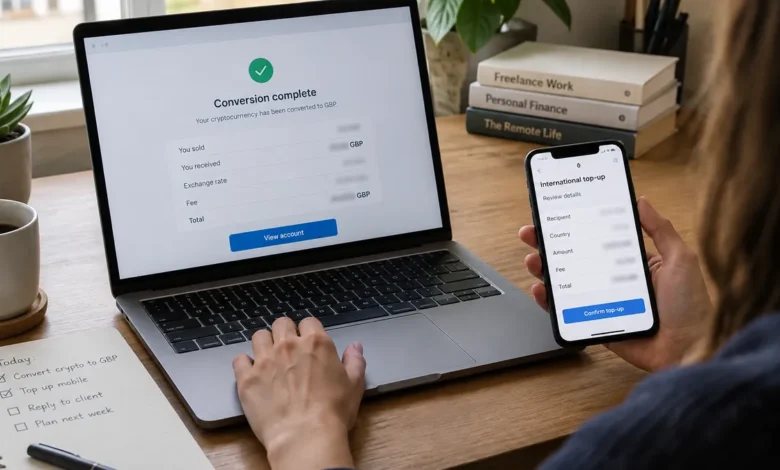
First, you sell an appropriate amount of cryptocurrency through a provider you have checked, then withdraw the proceeds using a supported route. Wait until the money is available to spend. A completed trade does not necessarily mean that a bank withdrawal has also completed, and a displayed portfolio balance is not the same as cleared cash.
Second, you purchase a top-up using a payment method accepted by the mobile-credit service. For example, Mobile top-ups with Numio start with choosing the destination country and entering a mobile number, followed by selecting an amount and paying. After payment confirmation, Numio submits the top-up to the operator. Its available payment methods appear at checkout and may vary by country, currency and device; do not assume that cryptocurrency is accepted or that you can connect a crypto wallet.
You are purchasing credit for a supported mobile number, not sending a cash transfer to the recipient. Before proceeding, ask whether they need ordinary airtime or a particular data bundle. Do not assume that every recharge includes mobile data, that airtime can be withdrawn as cash, or that topping up will automatically activate the plan they want.
Work backwards from the credit needed to set your cash-out budget
Start with the recipient’s requirement rather than the amount of crypto you feel like selling. Confirm the available recharge options and the total checkout price before committing to a cash-out. The amount charged to you, the currency shown at checkout and the credit delivered to the phone are different figures; compare them carefully rather than treating them as interchangeable.
Build a cost estimate across the whole route. A wallet transfer may incur a network fee; a sale may involve a trading fee or spread; withdrawing money may have a separate charge. The final purchase could also involve currency conversion by your payment provider. Not every route has all these costs, but a low advertised trading fee alone does not establish which route is cheapest.
- Confirm the recipient’s requested credit or bundle and the available denomination.
- Check the full purchase price and currency before payment.
- Review trading, network, withdrawal and currency-conversion costs that apply to your route.
- Allow for price movement while arranging the sale, without selling substantially more than you need.
Suppose the checkout total is £20 and your cash-out route has a fixed £2 withdrawal fee. Selling exactly £20 worth of crypto will not cover both if that fee is deducted from the proceeds. This is only an illustration, not a quoted service charge. Use your provider’s actual preview and keep any money needed for tax separate from the spending budget.
Convert and withdraw safely using a route you have checked
Check that your chosen provider supports selling your asset and withdrawing the proceeds to an account you control. Review withdrawal minimums, limits, identity-verification requirements and estimated processing times before transferring crypto. If you already have a suitable verified account, an unfamiliar platform advertising a slightly better rate may introduce unnecessary risks and delays.
The FCA’s guidance on Crypto investment scams explains checks that are useful when assessing a provider: search the Financial Services Register, examine the firm’s listed activities and match its contact details. Use independently verified details, not a link supplied by someone offering to arrange your cash-out. Registration alone does not mean you have access to the Financial Ombudsman Service or Financial Services Compensation Scheme.
If moving assets from a wallet, verify the receiving address, asset and supported network. Similar-looking token names do not make networks interchangeable. For an unfamiliar route, consider a small test where fees and minimums make that practical, while recognising that one successful transfer does not prove a provider is trustworthy.
Protect both the exchange account and the email account used for confirmations with strong, unique passwords and robust multi-factor authentication where available. Never share a seed phrase, private key or one-time code with support. Unexpected instructions to send more crypto to unlock a withdrawal are a reason to stop and investigate, not continue funding the account.
Verify the country, mobile number and operator-supported amount
Ask the recipient to confirm the destination country and the full mobile number, including the country code. Follow the top-up form’s formatting instructions, especially if the country code is already selected separately. Read back the final displayed number before payment rather than relying on a saved contact name or a number copied from an old message.
Country coverage is only the first check. A service supporting a destination does not necessarily support every operator, number type or recharge product there. Numio says it automatically identifies a supported operator from the entered number, while available operators and top-up options depend on the destination. Review what the form displays and investigate any mismatch with the recipient’s expectations before paying.
Amounts need checking too. Numio states that the final top-up amount depends on operator-supported denominations and may be rounded down to the nearest supported amount. If someone needs enough credit to activate a specific package, a slightly lower recharge could leave them short. Confirm the final amount rather than assuming the amount initially requested is what will be delivered.
Treat the last review screen as a real checkpoint: country, number, operator where shown, credit amount, payment currency and total charge. Submitted top-ups may not be reversible. Automatic operator detection does not replace your responsibility to check that the number belongs to the intended recipient.
Check payment, processing and delivery before trying again
If the recipient has not received credit, first establish where the delay sits. Has your crypto withdrawal reached your bank? Has the top-up payment been confirmed? Is the order still processing, marked as delivered or shown as failed? Those are separate events, and a bank payment notification alone does not establish that the operator has credited the phone.
Keep the confirmation email and order reference, then check the transaction status before placing another order. Numio describes status tracking through payment, processing and delivery. Although its help page says most top-ups arrive in under ten seconds, that is not a guarantee for every transaction. Repeatedly submitting a purchase can create duplicate orders if the original is still processing.
For an unresolved order, Numio help and support provides a contact form. Include your order reference, a clear description of the issue and the status you can see. Numio says unsuccessful top-ups receive an updated status and next steps; depending on the payment status and its Refund Policy, a pending authorisation may be released or a refund may be issued. Neither outcome should be treated as an instant, unconditional repayment promise.
Do not include card numbers, passwords or other sensitive payment information in the support message. A released authorisation and a refund are different payment events, so check which applies before interpreting your bank balance. If the order is marked as delivered but the recipient sees no credit, confirm the number and ask them to check their balance through the operator’s normal method, then report the discrepancy.
Keep records of the crypto disposal and the top-up purchase
For a UK crypto-paid freelancer, receiving crypto for work and later disposing of it are separate tax questions. The receipt may create an Income Tax obligation depending on the circumstances; a subsequent sale can produce a capital gain or loss. Moving the sale proceeds into a phone-credit purchase does not remove the need to assess the earlier disposal.
HMRC’s guidance, Check if you need to pay tax when you sell cryptoassets, explains that selling crypto for money, exchanging tokens and spending crypto can be disposals. In the route described here, the crypto sale is the disposal to record. The later mobile top-up is a separate fiat-funded purchase, not a second disposal of those same tokens.
Keep the date, token quantity, sterling value, relevant fees and cost-basis records for the sale, including pooled costs where applicable. Retain records of the original freelance receipt as well. If you exchange one token for another before cashing out, do not record only the final withdrawal: the intervening exchange may also need to be accounted for. Personal circumstances and applicable tax rules determine whether tax is actually due.
Save the top-up receipt separately, showing the purchase price, currency and order reference. A personal top-up for a relative is not automatically a deductible freelance expense just because crypto earnings funded it. The practical rule is straightforward: verify the cash-out route, spend only cleared funds, check the recipient’s details and retain evidence for both transactions. If your records involve many trades or mixed sources of crypto, seek qualified UK tax advice.