
Crypto mining is often discussed as if the mining machine were the whole system. In practice, a stable setup depends just as much on the electrical infrastructure around it: cable sizing, circuit protection, heat management, routing, monitoring and maintenance access. That is where a supplier such as https://voltashop.store/ becomes relevant to miners planning a dedicated room, workshop installation or small commercial operation. The useful question is not simply which miner to buy, but whether the site can deliver power continuously without creating avoidable voltage drop, nuisance trips or unsafe heat build-up.
This systems approach reflects the way mining economics actually work. Proof-of-work hardware converts electricity into repeated cryptographic calculations, so power demand is not an occasional requirement; it is a continuous operating condition. The US Energy Information Administration notes that mining facilities consume electricity both for computing equipment and for cooling, while operational profitability remains highly sensitive to energy costs. Its overview of cryptocurrency mining electricity use also shows why planners should treat electrical capacity, efficiency and cooling as one connected problem rather than separate purchasing decisions.
Start with the load, not the shopping list
Before selecting cables or protective devices, establish the expected load of the equipment. Record the rated input power of every miner, fan, network switch, pump, controller and auxiliary device. Then consider whether all units will operate at the same time, whether firmware settings may change their draw, and whether future expansion is likely. A design based only on the first machine can become inadequate as soon as a second unit is added.
Mining hardware is commonly operated for long periods, which makes sustained current more important than a brief peak. Conductors, terminals and breakers must therefore be selected for the real duty cycle and installation conditions. Ambient temperature, grouping of cables, enclosure ventilation and route length can all affect the suitability of a nominal cable size. The correct decision should follow local electrical rules and, for anything beyond a plug-in domestic appliance, be checked by a qualified electrician.
It is also useful to separate the theoretical maximum from the planned operating level. Running every circuit close to its limit leaves little margin for hotter weather, dust accumulation, fan degradation or additional equipment. A conservative design makes troubleshooting easier and reduces the temptation to improvise with extension leads, multiway adapters or underspecified connectors.
Cable selection is an engineering decision
Three questions should guide cable selection: how much current will flow, how far the circuit runs, and how the cable will be installed. Cross-section alone does not provide a complete answer. A cable clipped in open air behaves differently from one enclosed in trunking, buried in insulation or grouped with several other loaded circuits. Voltage drop also matters because a miner drawing substantial current over a long route may receive less voltage than expected, increasing stress on the installation and potentially reducing operating stability.
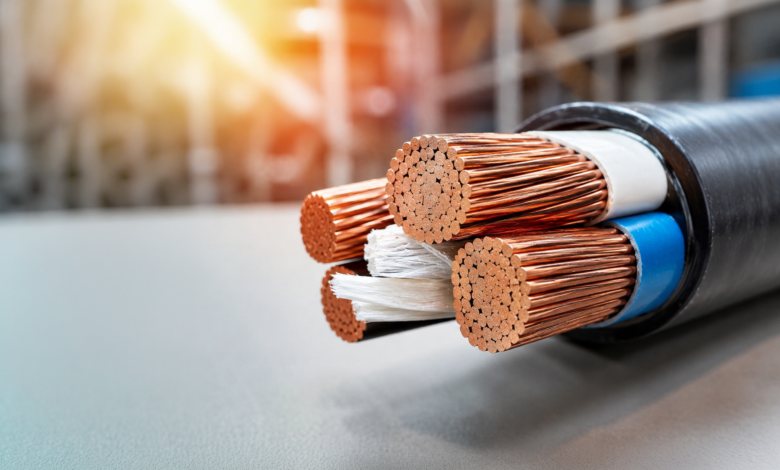
The electrical supplies catalogue includes cables and wires, cable duct and circuit breakers, which are the main component groups needed when planning the distribution side of a mining installation. Browsing by cross-section, rated current, material and enclosure characteristics can help organise the specification, but product selection should still be based on the calculated load and the applicable installation standard rather than on price or availability alone.
Copper conductors are widely used where compact dimensions and dependable connections are priorities, while flexible cable may be useful between fixed distribution points and equipment that needs to be moved for service. Fixed wiring, however, should remain mechanically protected and clearly routed. Cable duct can keep power runs separated from network cabling, reduce accidental contact and make later inspection more orderly.
Protection should isolate faults without stopping everything
A mining room should not depend on one protective device for every load. Dividing equipment into logical circuits makes it possible to isolate a faulty miner, cooling unit or accessory without shutting down the entire operation. It also improves fault finding: when one breaker trips, the affected group is immediately easier to identify.
Protective devices must match the cable and the characteristics of the load. A breaker is not simply chosen to prevent inconvenience; its main role is to protect the circuit against excessive current. Selecting a higher rating just because a smaller breaker trips can conceal an underlying problem such as overloaded wiring, a poor connection, an unsuitable start-up characteristic or a defective power supply. Residual-current protection, earthing and bonding requirements also depend on the installation and local regulations.
Selective coordination becomes more valuable as the setup grows. The goal is for the device nearest a fault to operate first, leaving unaffected circuits energised where safe. Achieving that outcome may require professional calculation rather than trial and error, especially when several distribution boards, high-current circuits or three-phase supplies are involved.
Heat changes the electrical calculation
Nearly all electrical energy used by mining hardware eventually appears as heat in the room. That heat influences both the miners and the wiring around them. High ambient temperatures can reduce allowable cable current, accelerate insulation ageing and increase the risk of loose terminals becoming problematic. Cooling is therefore part of electrical design, not an accessory added after installation.
Airflow should follow a deliberate path from cool intake to hot exhaust. Recirculating exhaust air raises inlet temperatures and forces fans to work harder. Cable routes should not block ventilation openings, and power distribution equipment should remain accessible without reaching across hot exhaust zones. In compact rooms, containment or ducting may be more effective than simply adding more fans.
The International Energy Agency has documented the long-term improvement in Bitcoin mining hardware efficiency. Better hardware efficiency can reduce the amount of electricity required per unit of computing work, but it does not remove the need for careful site design. Operators often respond to improved efficiency by adding more machines, which can bring total power and heat back to the limits of the installation.
Layout and cable management affect uptime
A tidy installation is easier to inspect, clean and repair. Power cables should be supported, labelled and kept away from sharp edges, hot surfaces and moving fan parts. Cable duct and trunking can create predictable routes, but they should not be filled so tightly that heat cannot dissipate or future changes become impossible.
Labelling should identify the circuit, equipment group and distribution point. A simple schedule attached to the board can record breaker assignments, cable types and connected loads. This documentation becomes valuable when a machine is replaced, a circuit is extended or an electrician needs to diagnose recurring trips.
Network and monitoring cables deserve similar attention. Keeping low-voltage data lines apart from power wiring can reduce interference and simplify maintenance. Remote temperature sensors, energy meters and alerting tools can help operators detect blocked airflow, rising consumption or a failed fan before the condition produces a shutdown.
Plan for maintenance before continuous operation begins
Mining spaces collect dust because they move large volumes of air. Dust on heatsinks raises component temperatures, while contamination around terminals and protective equipment makes inspection more difficult. Filters can reduce ingress, but they also add airflow resistance and require a cleaning schedule. The best arrangement is one in which filters, fans, breakers and cable connections can be reached without dismantling the entire rack.
Routine checks should look for discolouration, damaged insulation, unusual odours, loose mechanical support, abnormal fan noise and repeated protective-device operation. Thermal inspection by a competent person can reveal hot connections that are not obvious during a visual check. Any sign of overheating should be investigated promptly rather than treated as a normal feature of high-power computing.
Maintenance records are also useful for economic decisions. When one miner repeatedly causes trips, draws more power than expected or requires disproportionate cooling, its apparent hashrate advantage may not translate into a better operating result. Electrical data turns equipment management from guesswork into a measurable process.
A practical specification sequence
- List every miner and auxiliary load, including cooling and networking equipment.
- Calculate simultaneous demand and allow for realistic expansion.
- Confirm supply capacity, phase arrangement, earthing and local compliance requirements.
- Select cable type and cross-section for current, route length, installation method and temperature.
- Choose protective devices that protect the conductors and isolate faults sensibly.
- Design airflow and cable routes together so neither compromises the other.
- Label circuits, document connected loads and establish inspection intervals.
- Have the completed design and installation checked by a qualified professional.
The strongest mining setup is not necessarily the one with the highest headline hashrate. It is the one that can operate predictably, shed heat, isolate faults and be maintained without unsafe improvisation. Volta Shop fits this planning process as a source of cables, protective devices and routing materials, but the final specification must come from the load calculation and the installation environment. Treating electrical infrastructure as part of the mining system protects uptime, supports future expansion and makes energy use easier to understand.